
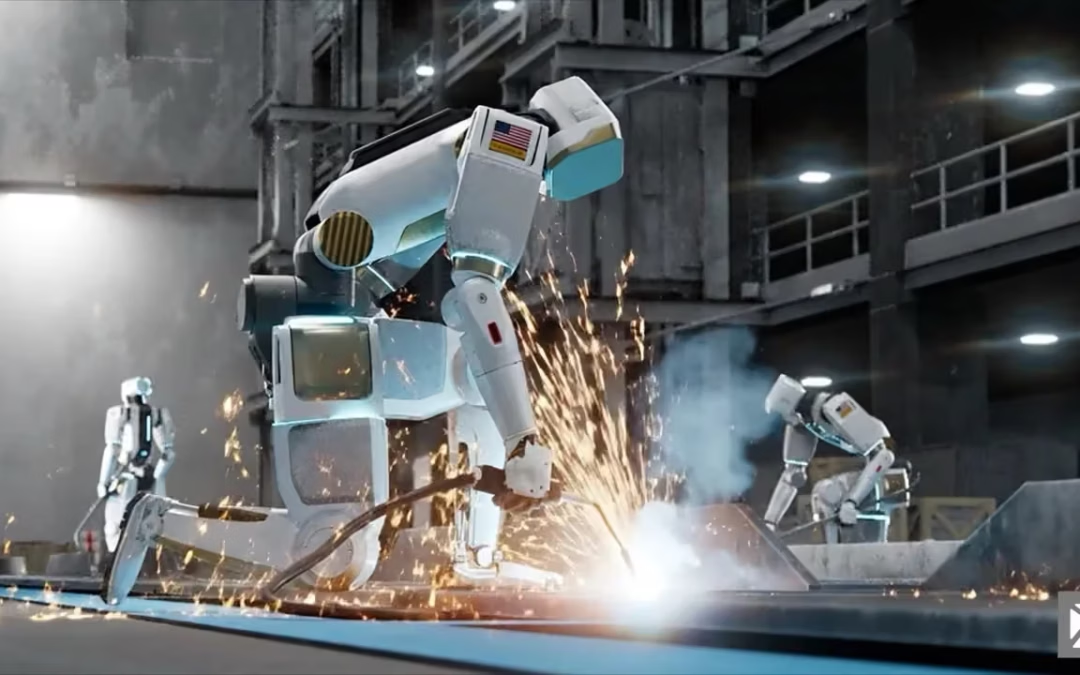
Shipbuilding has an access problem, not a welding problem
The humanoid robot industry has decided that shipyards need a mechanical welder shaped like a person. I believe that is the wrong robot for the job.
Walk into a ship block under construction. Stiffeners run across the floor every meter or so. Access holes are barely wider than a worker’s shoulders. Half the seams are on walls or overhead.
Before a welder strikes an arc, the shipyard has to deal with that geometry. It builds scaffolding. Or it uses a crane to flip an entire steel block so overhead seams become floor seams.
That preparation is the hidden cost of shipbuilding. Any robot that keeps it in place has automated the easy part and left the expensive part untouched.
The labor math is real
Nobody disputes the problem. Korean-national production workers at KOSHIPA member shipbuilders fell from 88,000 in 2023 to 72,000 in 2025. That is 16,000 fewer workers in two years.
Korea delivered roughly 60% of the world’s shipbuilding output outside China in 2024, measured in gross tonnage. When Korea runs short of welders, the global order book feels it.
The total shipyard workforce has recovered since 2021, but much of that recovery is foreign labor and subcontractors. Yards are filling seats. They are not solving the underlying shortage of skilled, domestic production workers.
So the question isn’t whether shipbuilding needs robots. It does. The question is which robot.
Two bets on the same problem
Two companies illustrate the choice.
Persona AI, based in Houston, is building a bipedal humanoid to weld in shipyards. It signed a joint development agreement with HD Korea Shipbuilding & Offshore Engineering and HD Hyundai Robotics. Its humanoid is designed to use the same tools human welders use.
Diden Robotics, a KAIST spinout in Korea, went the other way. Its DIDEN Spider is a low-profile legged robot with switchable magnetic feet. It doesn’t need a floor. It walks on walls and ceilings.
I don’t have a business relationship with Persona AI or Diden Robotics. I wish the best for both companies.
| Persona AI | Diden Robotics | |
| Robot | Bipedal humanoid | Magnetic-footed legged platform (Spider) |
| Design logic | Fit into human workflows, use human tools | Fit the steel structure, engineer the tool interface |
| Shipyard partners | HD Korea Shipbuilding & Offshore Engineering, HD Hyundai Robotics | Samsung Heavy Industries, Hanwha Ocean, HD Hyundai Samho, Fincantieri |
| Commercial status | Prototypes targeted end of 2026, commercial deployment from 2027 | Spiders delivered to Samsung Heavy (Dec 2025) and Hanwha Ocean (Aug 2026); 2 in procurement at Samho; Fincantieri contract (Jul 2026) |
| Funding | $65.4M sold of a planned $142M offering | Raising a $70M Series A |
| Welding | Teleoperated welding demos | Welding integration in development; first trial weld H2 2026 |
Notice that HD Hyundai sits on both sides of that table. So does Fincantieri, which bought a Spider while preparing to test a humanoid from Generative Bionics at its Genoa shipyard. The customers are hedging. I don’t think they need to.
A humanoid inherits human constraints and adds its own
The case for humanoids rests on one idea: the world is built for people, so build robots shaped like people. That logic works in a warehouse aisle. It breaks inside a ship block, because a ship block isn’t built for people either. People just endure it.
Here is what a humanoid welder inherits from the human it replaces, and what it adds.
It can’t reach where a person can’t reach. Much of the confined-space welding in a hull sits behind small openings, in tight compartments, and in awkward positions. A human-sized machine can’t physically get to that work. This is a geometry problem, not an AI problem. No amount of training data makes a robot narrower.
It gets stuck, and it can’t wiggle out. A human wedged in a compartment twists, exhales, and backs out. A humanoid built on precision joints with limited backdrivability, such as harmonic drives, doesn’t give when it hits steel. Sending another position command doesn’t free a rigid arm pinned against a bulkhead. Managing contact forces and recovering safely become the central engineering problem. Truly squeezing a humanoid through these spaces would eventually require something closer to soft robotics, or a far more compliant, reconfigurable body. At that point you aren’t making a humanoid work in a hull. You’re building a different robot, with a new set of engineering problems.
It would need skin. Cameras and LiDAR can’t see surfaces pressed against the robot’s own body. A humanoid crawling through tight spaces would need tactile sensing across most of its body, plus control software that reacts to contact in real time. All of that has to run on the robot’s onboard compute, inside its power and heat budget. That hardware largely doesn’t exist today at a price that works.
Its hands aren’t ready. Humanoid hands remain the least mature part of the platform. Basing a production plan on general-purpose robotic hands doing harsh, repetitive welding work is a bet on a technology that hasn’t arrived. A purpose-built tool interface is more reliable, and it exists now.
Its mobility advantage disappears. A welding robot is tethered no matter what shape it is. It needs power, shielding gas, and wire feed. Once the robot is dragging cables through stiffeners anyway, the untethered freedom of a walking humanoid is gone. What’s left is a tall, top-heavy machine picking its way across an obstacle course.
Put those together and a humanoid doesn’t remove the constraints that make shipyard welding hard. It keeps every one of them and adds new failure modes of its own.
Automating the worker versus redesigning the work
This is the point I think the humanoid camp keeps missing.
Suppose a shipyard buys an expensive humanoid and it does the welder’s job a little worse than the welder, inside the same workflow. The yard still builds the scaffolding. It still flips the block. It still prepares every access route so the robot can reach the seam.
How much of the cost structure has actually changed? The yard swapped a wage for a capital asset and a maintenance contract. The scaffolding crews, the crane time, and the schedule delays all remain.
A purpose-built robot attacks the process itself. If a robot can attach to a wall or ceiling, the scaffolding that exists only to provide access starts to go away. So does some of the block turnover. That’s where the money is.
There’s also a bill-of-materials argument. A compact, purpose-built machine needs fewer actuators, fewer sensors, and less material than a full humanoid with two arms, two legs, a torso, a head, and a pair of dexterous hands. Fewer parts means a lower build cost and fewer things to break. A compact architecture should also be faster and useful across a wider range of difficult-access steel tasks, from welding to grinding, coating, and inspection. That is still an advantage purpose-built vendors have to demonstrate, not assume.
And there’s a labor argument that gets little attention. Today’s humanoid welding demos are largely teleoperated. A teleoperated humanoid still needs a skilled human behind the controls. Unless one operator can run many robots at once, you haven’t solved a labor shortage. You’ve moved the welder into a control room.
I’ve made a version of this argument before about warehouse and grocery automation. The winners redesign the process around the machine. The losers bolt a machine onto a process designed for people and wonder why the ROI never shows up.
Don’t bet the business on a VLA timeline
The humanoid pitch leans heavily on general-purpose AI. Vision-language-action models, the argument goes, will soon let one robot learn any task.
Someone will eventually solve much more of general physical AI. But broadly reliable, commercially meaningful VLA robotics could easily be a decade or more away. Useful applications may appear sooner. A shipyard’s production plan shouldn’t depend on it.
Self-driving cars are the cautionary tale. In the early 2010s, the industry talked as though autonomy was nearly solved. A demo, a deployment at scale, and breakeven turned out to be three very different milestones, separated by years and billions of dollars.
The unsolved problems are specific:
- A robot takes in a continuous stream of camera frames, LiDAR, encoder readings, and motor currents. What should it keep? How does it compress that experience and recall the right piece later, while still controlling a physical machine? Language compresses well. Continuous physical experience doesn’t. In people, something like the hippocampus turns a flood of sensory experience into compact, recallable memory. Robots have no equivalent yet.
- Adaptation without drift. A robot that learns from new experience on the job can also become less predictable. In a shipyard, unpredictable is unacceptable.
- Compute on the robot. A model that performs well on a data center cluster still has to run on the robot, inside real power and heat limits.
- Honest evaluation. Too much of the conversation runs on cherry-picked demo videos. What matters is repeated performance: failure rates, human interventions, and recovery.
Then there’s the cost of getting there: years of data collection, expensive AI researchers, training infrastructure, and evaluation before a customer gets a dependable weld. That’s a lot of capital to spend while the order book waits.
Aim for 80% automation, not 100% autonomy
Shipyards are heavily mechanized. Cranes, panel lines, and fixed welding robots are everywhere. But mechanization isn’t automation, and it certainly isn’t digitalization.
A reasonable working estimate is that the block-assembly environments these robots target sit somewhere around 10% to 20% automation, varying widely by process. Moving that toward 80% would transform shipyard economics. It doesn’t require a robot that can do everything.
Most of that gain can come from tools the industry already understands: deterministic control, rule-based workflows, and reinforcement learning applied to narrow, well-defined problems, all under a carefully engineered safety layer. A robot navigating a block whose CAD model is known, along prepared waypoints, to a known seam, is a solvable problem today.
That’s the strategic difference. The humanoid camp is chasing 100% autonomy in a general-purpose body. The purpose-built camp is chasing 80% of the commercially important jobs, done reliably and repeatedly at an acceptable cost. The second group gets paid first.
Whoever deploys practical systems before general-purpose robots become commercially competitive has a real chance to lock up the market. Customer references, field data, and integration into yard workflows compound. Late entrants with better AI will still have to displace an incumbent that already works. Diden’s stated ambition is to capture a majority of its initial target market within three to five years, before general-purpose approaches become commercially competitive. That window is the whole game.
The hardest problems are hardware problems
The robotics conversation is dominated by AI. The questions that decide whether a shipyard robot pays for itself are mostly mechanical.
Can the robot operate reliably for five to ten years in a coastal industrial environment? Shipyards mean salt-laden air, grinding dust, weld spatter, fumes, heat, and constant vibration. Every exposed joint, connector, and sensor window is a failure point.
Can it be maintained by the yard, or does every fault require a flight from the vendor? Can a technician swap an actuator in an hour? When a robot fails inside a closed block, how do you get it out?
That last question matters more than it sounds. Confined-space entry is one of the most regulated activities in a shipyard. A stranded robot inside a compartment is a production stoppage, and possibly a rescue operation.
Humanoids make every one of these problems harder. More joints mean more seals, more wear, and more ways to fail. A fall from a biped is a repair event. A heavy humanoid stuck behind an access hole is a crane job.
This is where I’d push every vendor, humanoid or not. Show me mean time between failures, mean time to repair, and a recovery procedure for a dead robot inside a block. Until then, service life is a design requirement, not a claim.
Where Diden stands today, honestly
I believe Diden is on the right path. That doesn’t mean it has arrived, and its own materials are candid about the gap.
What’s proven. The Spider’s electro-permanent magnetic feet hold 2,200 N each from a 1.8 kg foot and switch between attach and release in about 10 milliseconds, roughly 100 times faster than commercial units. The feet hold without continuous power. Its in-house actuators produce 387 Nm of peak torque from a 2.0 kg unit. The robot has completed a three-stiffener crossing sequence with a manipulator onboard and a field access route involving ground, wall, and opening transitions.
What customers are buying. Samsung Heavy Industries took delivery of a Spider in December 2025. Hanwha Ocean took one in August 2026. HD Hyundai Samho has two in procurement. Fincantieri signed Diden’s first European purchase contract in July 2026.
What isn’t proven yet. Customers are buying the mobility platform. Welding integration is still in development. The next milestone is a single 300 to 500 mm trial fillet weld inside one block in the second half of 2026. Stiffener crossings take up to 60 seconds each today, with a 30-second target. Weld spatter on the floor has disrupted motion tracking in trials. Autonomy currently relies on known CAD models and prepared waypoints.
The business. Diden reported $74,000 in 2025 revenue and is raising a $70 million Series A. Its forecast of roughly 2,000 robots and $170 million in revenue by 2030 is a plan, not a result.
Diden also runs humanoid research, including a biped that has carried 32 kg. Critics will ask why a company skeptical of humanoids builds one. My read: it’s long-term R&D, and its commercial product is the Spider. That’s the right order of priorities.
My questions for shipbuilding’s leaders
To Chung Ki-sun, Chairman and CEO of HD Hyundai; Kim Wan-soo, CEO of HD Hyundai Robotics; and Pierroberto Folgiero, CEO of Fincantieri:
Why do you want to invest time, money, and effort trying to replace humans whose limitations are already proven, with machines that inherit those limitations and add their own?
Why aren’t you maximizing investment in a solution that meets your needs while eliminating the constraints?
You are backing both bets. HD Hyundai is co-developing a humanoid with Persona AI while HD Hyundai Samho procures Spiders. Fincantieri signed a Spider purchase contract while preparing to test a humanoid in Genoa. I’d like to know which bet you expect to win, and why.
To Choi Sung-an, Vice Chairman and CEO of Samsung Heavy Industries; Kim Hee-cheol, CEO of Hanwha Ocean; and Kim Jae-eul, CEO of HD Hyundai Samho, whose yards already have Spiders or are buying them:
What will you need to see before you scale? A cost per meter of accepted weld? A maximum number of human interventions per shift? A proven recovery procedure? Say it publicly, and every vendor in this market will know the bar.
Build the robot for the job
The humanoid is an elegant idea. It promises one machine for every task in a world built for people. But shipyards aren’t built for people. They’re built for steel, and people have spent a century working around that fact with scaffolding, cranes, and endurance.
A humanoid welder keeps all those workarounds and adds its own weaknesses. A robot designed around the steel removes them.
To be clear, I’m not saying humanoids will never have a role. There will be tasks and environments where a human-shaped machine makes sense. Shipyard welding isn’t one of them, and even where a humanoid fits physically, the road to reliable, economical deployment is long.
Build the robot for the job, not the robot that looks like the person who used to do it.