
McDonald’s has made one mistake in its history that cost more than all the others combined. Understanding that mistake explains the biggest opportunity in the restaurant industry today—and why one founder in Phoenix is better positioned to capture it than anyone else, including McDonald’s.
The Chipotle lesson.
In 1998, McDonald’s invested roughly $360 million in a small Denver restaurant chain called Chipotle, founded by a chef named Steve Ells. Chipotle had 16 locations. McDonald’s capital funded its growth, and by 2006 Chipotle had more than 500 restaurants. That year, McDonald’s sold its entire stake for about $1.5 billion so it could focus on its core business.
The decision looked disciplined at the time. In hindsight, it was the most expensive divestiture in restaurant history. Chipotle went on to become one of the most valuable restaurant companies in the world, at its peak worth more than $80 billion. McDonald’s had owned the future of fast food, a founder-led concept with a genuinely new way of operating, and let it go for a fraction of what it became.
The lesson is not that McDonald’s should have kept running Chipotle. The lesson is that when a founder invents a new restaurant operating model, the invention is worth far more than it appears, and the founder is the asset. Keep that lesson in mind. The same setup exists today.
The demand nobody is serving.
American eating habits are shifting toward protein, and the shift is large. Based on a review of the research, roughly 62% of consumers now actively look for high-protein options when eating out, close to 40% will pay more to get them, and nearly half say they would switch brands for better protein choices. GLP-1 medications are accelerating the trend: millions of Americans now eat smaller portions and prioritize protein in every meal.
The fast-food industry’s response has been labels, not food. McDonald’s recently added protein “callout” badges to existing menu items…the same burgers, re-described. No national chain has been built for this consumer: meals with 30 or more grams of protein, full nutrition printed on the menu board, served fast, at fast-food prices, through a drive-thru.
Building that chain is not a menu problem. Plenty of small concepts have protein-heavy menus. It is an operating-model problem: how do you serve high-quality protein meals at $8 to $12, at drive-thru speed, profitably? Only one operator in America has spent his career solving exactly that class of problem.
What Tony Christofellis built the first time.
Tony Christofellis and his wife Roushan, founded Salad and Go in Arizona in 2013. The idea was simple to state and hard to execute: fresh, healthy food at fast-food prices. The execution was a genuine invention. Instead of putting a kitchen in every restaurant, Salad and Go prepared food in one central kitchen and delivered it daily to tiny drive-thru buildings that are roughly 700 square feet, no ovens, no dining room, and minimal staff. Every dollar saved on kitchens, equipment, and labor showed up in the price: salads for around $6 when competitors charged $12.
The couple grew Salad and Go to about 40 locations and sold the company to a private equity firm in 2021. The new owners set out to make it a national chain. They moved its headquarters to Texas, hired an experienced CEO, opened roughly a store per week, and built a central kitchen in Garland, Texas, sized to supply 500 restaurants. By spring 2025 the chain had about 140 locations.
Then it collapsed. Over five months, Salad and Go closed 73 restaurants, exited Texas and Oklahoma completely, shut the Garland kitchen and the Dallas headquarters, and retreated to roughly 70 stores in Arizona and Nevada. The company is now half its original size. Its current CEO, Mike Tattersfield, a former head of Krispy Kreme and Caribou Coffee, has stated that too many stores were put in the wrong places, and commissary in Garland, Texas was underutilized and not worth keeping.
Why it really failed.
The financial explanation is true but incomplete. The deeper problem was the product itself, in two ways.
First, salads and drive-thrus don’t mix. Most fast-food meals are eaten in the car, and eating requires one hand. A salad needs two hands, a fork, and dressing. However good the price, a salad is something most people buy occasionally and not several times a week. Demand had a ceiling built in before a single Texas store opened. This is why I criticized Salad and Go to several of the investors in the company who contacted me and asked for my opinion. I stated, “Try eating a salad in your car as you’re driving. You won’t it make it a mile before you drop the salad or crash your car. Selling salads via a drive thru is a bad idea.”
Second, salads and central kitchens don’t mix. A central kitchen works best with foods that hold: sauces, marinated meats, cooked proteins. You can produce them ahead and keep the kitchen running efficiently even when store demand fluctuates. Lettuce wilts in hours, not days. Production has to match demand almost in real time, and a kitchen built for 500 restaurants supplying far fewer has no cushion. Low utilization on a huge fixed cost is how the money runs out. Just ask Kroger who had to shut three of their Ocado CFCs due to high operating costs and severe underutilization.
In short: the operating model was sound, but the product was wrong for the model. It worked as a regional business at 40 stores and broke when scaled to a size the product could never support.
What Christofellis built the second time.
While Salad and Go struggled under its new owners, Christofellis was building his next company, and every major flaw of the first one has been corrected in the second.
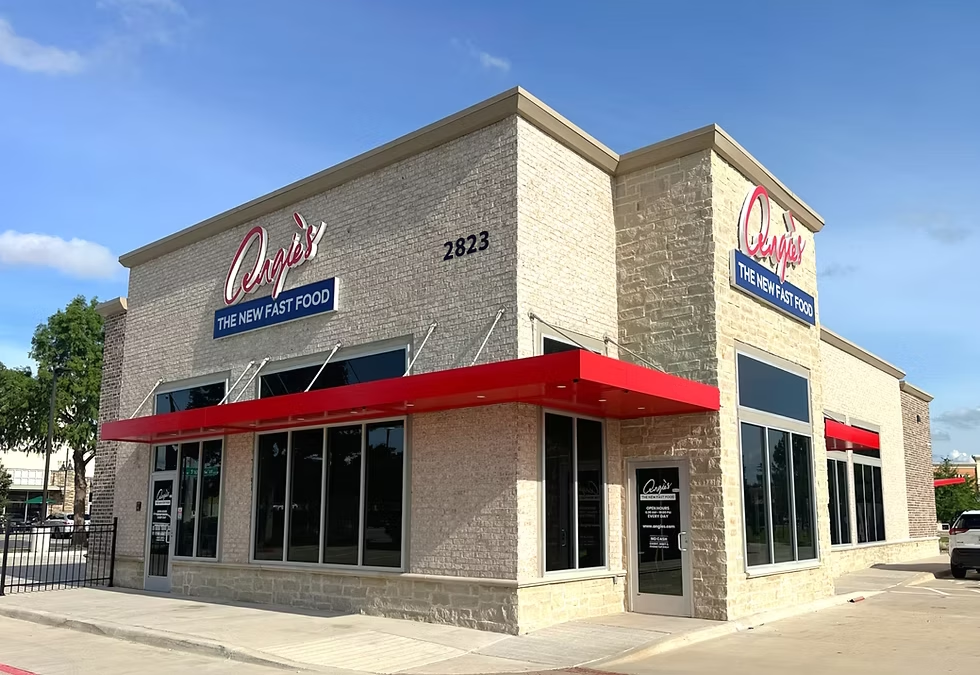
Angie’s Food Concepts, named for his late mother, operates about 20 restaurants across Arizona and Las Vegas under several brands—Angie’s Lobster, Angie’s Prime Grill, Angie’s Burgers—with a first Texas location now open in Plano. The company is vertically integrated to a degree almost unheard of at this size: it owns a lobster wharf in Maine, a seafood processing plant, a Phoenix distribution and production center, and its own trucks. The restaurants use a drive-thru with no order-taker…customers order at a kiosk or on their phones, and the food is waiting at the window. There is no marketing budget. The savings show up on the menu: lobster rolls for $9.99, burgers for $6.99.
Compare Angie’s to Salad and Go, and you’ll see how improved the company is:
The food is made for the car. Lobster rolls, burgers, sandwiches, chicken tenders—one-handed food, matched to how fast food is actually eaten. Salad and Go sold fork food through a car window; Angie’s does not repeat that mistake.
The food is made for the central kitchen. Proteins, sauces, and marinades hold and can be produced ahead, keeping the kitchen efficiently utilized…exactly where lettuce punished the first model. The proteins themselves are grilled fresh in each store on a specialty grill that sears both sides at once, so quality never depends on reheating. Centralize everything except the protein.
One kitchen now feeds multiple brands. Several Angie’s locations serve two menus from the same building. More demand flowing through the same fixed costs directly cures the underutilization that broke Salad and Go.
And protein demand is already showing up in his stores. The Prime Grill menu includes a protein bowl section where portions scale up to quadruple protein of four servings of chicken with four sides for $10.99, with nutrition figures printed beside the items. No restaurant adds a 4x-protein option unless customers keep asking for it. And Americans hooked on GLP-1 drugs, are asking for lots of protein.
Christofellis has, piece by piece, assembled the operating model for the protein chain America doesn’t have yet. What he hasn’t done is name it and scale it. I tried to convince a restaurant chain called the Protein House, to become America’s first true protein chain, but the company’s menu is too complicated and expensive for a drive-thru.
The opportunity sitting in plain sight.
This is the most interesting piece of this story, and its why I chose to write this article. The fastest way to scale Angie’s is currently sitting empty along the highways of Texas, Oklahoma, Arizona, and Nevada.
Salad and Go’s contraction left behind roughly 73 closed drive-thru buildings, most still vacant, plus the Garland central kitchen built to supply 500 restaurants. These assets are nearly worthless to most buyers as the units are small, single-purpose buildings along with an oversized commissary. To Christofellis, they are pre-built infrastructure: drive-thru locations constructed to a format he designed, and a Texas production hub sitting in the same metro area Angie’s just entered. Distressed sellers on one side, the one buyer who can fully use the assets on the other. Acquiring them, selectively, could compress years of construction timelines into months, at a fraction of replacement cost.
Selectivity is the operative word. Some of those stores are closed because the locations were poorly chosen during a store-a-week expansion. The right approach is site by site, and Christofellis already has the testing tool: he currently incubates new concepts in a food truck parked behind an existing restaurant. A truck stationed near a vacant site for 60 to 90 days turns a real estate guess into a measurement before any lease is signed, and because he owns the commissary that supplies it, that test costs him almost nothing. The conversions of the units aren’t free, however. The buildings have no cooking equipment, and Angie’s grills on site, but retrofitting an existing drive-thru is far cheaper and faster than building one.
Done well, this single move accomplishes two things at once. It accelerates Angie’s existing brands into Texas years ahead of schedule. And it provides the ready-made footprint for the bigger prize: launching the first true protein QSR that offers meals with a minimum of 30-grams of protein, full nutrition on the board, $8 to $12 checks, at drive-thru speed, on infrastructure no competitor can match.
Should McDonald’s be part of this?
If McDonald’s learned anything from Chipotle, Christofellis is precisely the founder it should want to back: a proven format inventor, currently compounding, sitting on the category opportunity of the decade. McDonald’s can make a minority investment, ring-fenced, with the founder in full control, to give it a stake in the protein era it is currently answering with menu labels.
But the honest analysis is that Christofellis doesn’t need it. What McDonald’s offers is capital, and capital is available on better terms elsewhere. His buildings sit on some of the most financeable real estate in America, drive-thru pads, and companies like Raising Cane’s have proven that a founder can fund national growth through debt against strong store economics while keeping ownership. Christofellis also has personal experience with what outside ownership can do to a founder’s operating model; he watched it happen to his first company. Whether he would take a strategic partner at any price is an open question, and his history suggests the answer.
Twenty years ago, McDonald’s had the future of fast food in its portfolio and sold it. The next Chipotle-sized opportunity is taking shape now, assembled from the lessons, and the leftover buildings, of a failed salad chain. The question worth watching is not whether someone builds America’s first protein restaurant chain. It is whether Tony Christofellis builds it alone.